Being called a “jack of all trades” is seldom a compliment, but it’s that precise generalist approach that keeps me subscribed to Spotify. Whether you’re a music fanatic or casual listener, Spotify will work for you. Audio quality may not be the best, but I don’t prioritize that on a daily basis. Instead, I’m championing Spotify for its social, intuitive, and cross-platform functionality.
Spotify Music Premium MOD APK Download The Latest Apk Version of Spotify Pro MOD, A Music & Audio App Android. This Cracked APK Includes Premium Features Full Unlocked and Ads-Free. Download Yours Now! Get Spotify Premium Mod App for free to enjoy ad-free experience and premium features for an unlimited time. Safe, updated and tested. To do this, head to the “Preferences” menu. On Windows, click Edit Preferences. Mac users will need to head to the menu bar and press Spotify Preferences instead. For Android users, press the settings gear icon on the “Home” tab. By default, Spotify’s volume normalization setting is enabled.
Editor’s note: this article was updated on October 7, 2020, to include a poll about readers’ favorite music streaming services.
Music discovery is silly simple
Spotify’s curated playlists are more hit than miss.
The number one reason I use Spotify over all other music streaming services is its top-notch discovery playlists and suggestions. Sure, Spotify’s algorithms don’t always nail it—especially if you share a single account with others—but more often than not, it impresses users with how intimately it understands their musical preferences. Not only is this something that I’ve discussed with my friends, but it often sparks entertaining Twitter threads. In fact, sometimes those digital discourses make their way onto subway cars. Spotify did just his with as a Dave Horowitz’ tweet:
.@Spotify a friend in NYC just informed me that this tweet has reached the highest heights: dirty subway ad! pic.twitter.com/I1rLT7cpHf
— dave horwitz (@Dave_Horwitz) June 21, 2016
Suggestions go beyond the personalized Discover Weekly playlist, though. Spotify also curates a Release Radar playlist every week, which it loads up with new music from artists-of-interest. Every Monday, I deliberately get through both of these complementary playlists. After all, it’s hard to find good, new music while keeping tabs on your favorite artists, both of which Spotify handles effectively.
Spotify keeps listeners listening with its Discover and Release Radar playlists.
Listeners who want to put a little elbow grease into finding new music can wade through any number of artist and song-specific radio stations. Frankly, I’m new to this feature but use it on a weekly basis. Sometimes I really dig one or two songs by a band but am not a huge fan of their oeuvre. When this happens, I leave it up to the given station to float similar artists to the surface.
Spotify makes it easy to switch between music and podcast media from the user library.
Sometimes I don’t want to listen to all-new or all-familiar music, which is when I click through the Daily Mix playlists. These are unending playlists filled with music by followed artists alongside similar artists. It’s great for when I don’t want a tacky mood playlist but want to hear a consistent, similar sound. I used these a lot when I lived in Atlanta and my weeks were filled with driving.
Again, these playlists don’t hit it out of the park every day or week, but they do a better job than any other music service I’ve used, including Pandora. Anyone with an insatiable appetite for music will appreciate the efforts Spotify goes through to fine-tune its algorithm and keep listeners listening. For listeners willing to go the extra mile, there are even craftier ways to find new music abound.
Social features are deceptively useful
You can only view friends’ activities through the desktop application.
The “friend activity” column makes it easy to see what your best friends and frenemies are rocking out to. This adds another dimension to music discovery: the social aspect. Not only can you surreptitiously creep on what your friends are listening to, but it also serves as an easy ice breaker for reaching out to distant friends. For instance, if a friend I haven’t spoken to in a few months is listening to an album I enjoy, I try to fire off a text asking how they like the album and seeing how they’ve been. While rekindled friendships are a triumph of Spotify’s friend activity section, I’d be remiss without mentioning how fun it is to see the musical guilty pleasures my friends have, too. The main drawback to this is that it’s only available on the desktop app, and doesn’t appear to be making its way to the mobile app anytime soon.
I love sharing music with others, and doing so is effortless with Spotify.
Spotify also affords listeners the ability to create collaborative playlists. Not all streaming services allow this functionality, which is a shame. I mean, really, what better way to prepare for a road trip with your friends than with a single assemblage of tasteless throwbacks?
Music integration on social apps
Yeah, that little green circle has made waves since its release and is the most well-integrated music streaming app available. Do you think your Instagram Story could use a little underscoring? The Instagram Story music widget is powered by Spotify. Is it important for you to know someone’s musical taste before giving up a precious right-swipe? Spotify enables that, too, on dating apps like Tinder and Bumble. If nothing else, it’s a fun way to add flair to your social media presence.
Find nearby concerts
I was able to photograph Aaron West, because Spotify made me aware of his then-upcoming show.
Music doesn’t get more social than going to concerts and festivals: Spotify makes it easy to keep track of upcoming concerts for any artists you follow. From the desktop application, go to “browse.” Then select “concerts,” which is the furthest tab on the right header. The next window opens with a chronological list of nearby concerts. Clicking on a specific concert reveals the date, time, and place of the show. The “find tickets” button opens a window in your default browser, so you can get tickets on the spot. It’s a little clunky, but works well, and is a great way to get an aerial view of upcoming shows.
User interface is everything
Spotify has the most attractive user interface, and certainly outperforms YouTube Music’s UI; its all-black design makes it easy for the eye to identify what’s important on the page. Navigation is easy due to the straightforward layout that logically breaks content up into three broad categories (“home,” “search,” and “your library”). Spotify’s system uses a logical hierarchy with headers and album art in the Home tab.
It’s the little functional tricks that keep this as my go-to streaming app. With the “now playing window” open, I frequently swipe the album art to skip a track. Once the command is registered, a smooth animation plays, moving the album in tandem with the finger-swipe. Sure, I could just use the playback iconographs, but this just feels smooth. While Amazon Music HD has the same functionality, it just doesn’t look as neat; plus, the command isn’t always registered. As for Tidal, it lacks this ability altogether. Instead, swiping album art pulls up the song queue.
Spotify car view reduces distractions
Car view simplifies the interface, so distractions are lessened.
My car doesn’t have Android Auto but even so, Spotify recognizes when my Samsung Galaxy S10e is connected to my car and automatically enters “car view.” This mode minimizes distractions and displays only the necessities to users: album art and the options button on the “now playing” screen are no longer visible. This places emphasis on driving, rather than messing around on one’s phone during stops. If your car and device are compatible, you can use either Apple CarPlay or Android Auto with Spotify.
Google Chromecast Audio integration
Spotify
Not only is direct Spotify access available from virtually every smart speaker on the market, but the desktop and mobile Spotify applications both support Chromecast Audio. This means you can cast audio playback to a nearby smart speaker from the Spotify app. There are other ways to connect, too, you can stream to computers, TVs, gaming consoles, and Bluetooth devices all without leaving the Spotify app. I use this all the time, frequently switching between my apartment Sonos, true wireless earbuds, and PlayStation 4. Its performance is consistent, and almost always makes a successful connection on the first try.

Low price, high return
Amazon Music HD costs $8/mo for Prime members, but its app isn’t as fleshed out and discovery suggestions aren’t nearly as satisfying.
Ultimately, Spotify’s low-cost is what keeps me subscribed. It’s just $10 per month on the individual plan, which affords ad-free listening, offline downloads, and on-demand playback. Spotify’s library hosts over 50 million songs, which is 10 million less than Tidal but 10 million more than Google Play Music. For just $10 a month, I have access to all the music my ears could want and numerous ways to discover new artists.
As of July 1, 2020, Spotify Duo Premium expansion includes support in the United States, India, and dozens of other markets, totalling 55 markets. This requires a monthly payment of $12.99, and keeps both users independent accounts along with the saved music and playlists associated with each account.
Spotify is the only service to offer a free, ad-supported version of its service to listeners, making it the most accessible service to listeners of all financial backgrounds. Yes, others offer free-trial periods like Spotify, but others automatically rope users into a subscription unless it’s cancelled prior to the trial period ending.
Spotify integrates well into social media applications like Instagram.
Although audio quality isn’t the best, Ogg Vorbis 320kbps streaming is nothing to turn your nose up at. If you want high-resolution FLAC audio files, you’ll have to pay extra for something like Amazon Music HD or Tidal. If you’re concerned about Spotify underpaying artists per stream, you may want to turn your attention to another service. Unfortunately, low payout rates are a systemic issue across the board of music streaming services. Listeners who really want to support their favorite artists are likely already doing so by attending concerts, buying merch, purchasing music.
Although Spotify has its drawbacks as SoundGuys’ own Sam Moore points out in his in-depth review, it’s a great service and one that continues to satisfy users month after month. It’s the generalist’s music app and does everything very well, albeit not perfectly. Until others figure out a way to smoothly introduce social features and improve their respective music suggestion algorithms, I’ll be keeping that green dot on my phone’s home screen.
You may also like
Best music streaming services
YouTube Music vs Spotify
Amazon Echo can now stream Spotify
The Beatles are now available on music streaming services
Spotify inks deal to bring their service to a Starbucks near...
Spotify announces playlist targeting for brands
Despite strong competition from Apple Music, Spotify is still by far the most loved music-streaming app. One of my favorite features of this app is the ability to let users ideally customize audio quality. If you are a big fan of this music app, you would really appreciate this complete guide about how to adjust equalizer and audio settings in Spotify on iPhone, iPad, Android, and Computer.
You have several options to make Spotify sound better. For example, you can set the same volume for all songs to have a more streamlined experience. More after the break…

How to Adjust Audio in Spotify on iPhone
Step #1. Open Spotify on your iOS device and tap on Your Library in the menu at the bottom of the screen.
Step #2. Now, you have to tap the Settings icon.
Step #3. Next, tap on Music Quality.
Then, you have to choose your preferred settings.
- Normal: It’s equivalent to almost 96kbit/s
- High: It’s equivalent to approximately 160kbit/s
- Extreme: It’s equivalent to approximately 320kbit/s
- Automatic: It depends on your network connection
Note:
- You can choose to use different settings for listening online or offline
- Do note that the higher the stream quality, the more data will be used on your device
How to Adjust Equalizer in Spotify on iPhone
Step #1. Open Spotify → Your Library → Settings.
Step #2. Tap on Playback.
Step #3. Next, tap on Equalizer and turn it on.
Up next, you can tap a preset customize it by dragging the dots on the equalizer. There is also an option to turn on Audio Normalisation and Feedback Sounds.
How to Change Audio Settings in Spotify on iPad
Step #1. Open Spotify app on your iPad and tap on Your Library in the menu at the bottom of the screen.
Step #2. Now, tap on the Settings app and select Music Quality.
Step #3. Next, choose your preferred settings.
Next up, choose from the following audio quality settings, all in the Ogg Vorbis format: you have four options like Normal, High, Extreme, and Automatic.
How to Adjust Equalizer in Spotify on iPad
Step #1. Open Spotify app → tap on Your Library in the menu at the bottom of the screen.
Then, tap on the Setting icon and select Playback.
Step #2. Now, tap Equalizer and turn it on.
Step #3. Next, select a preset, or customize by dragging the dots on the equalizer.
Fine-tuning audio and equalizer on the Android device is just as easy.
How to Change Audio Settings in Spotify on Android
Step #1. Open the Spotify app on your Android device. Then, tap on Your Library in the menu at the bottom of the screen.
Step #2. Now, tap on the Settings icon.
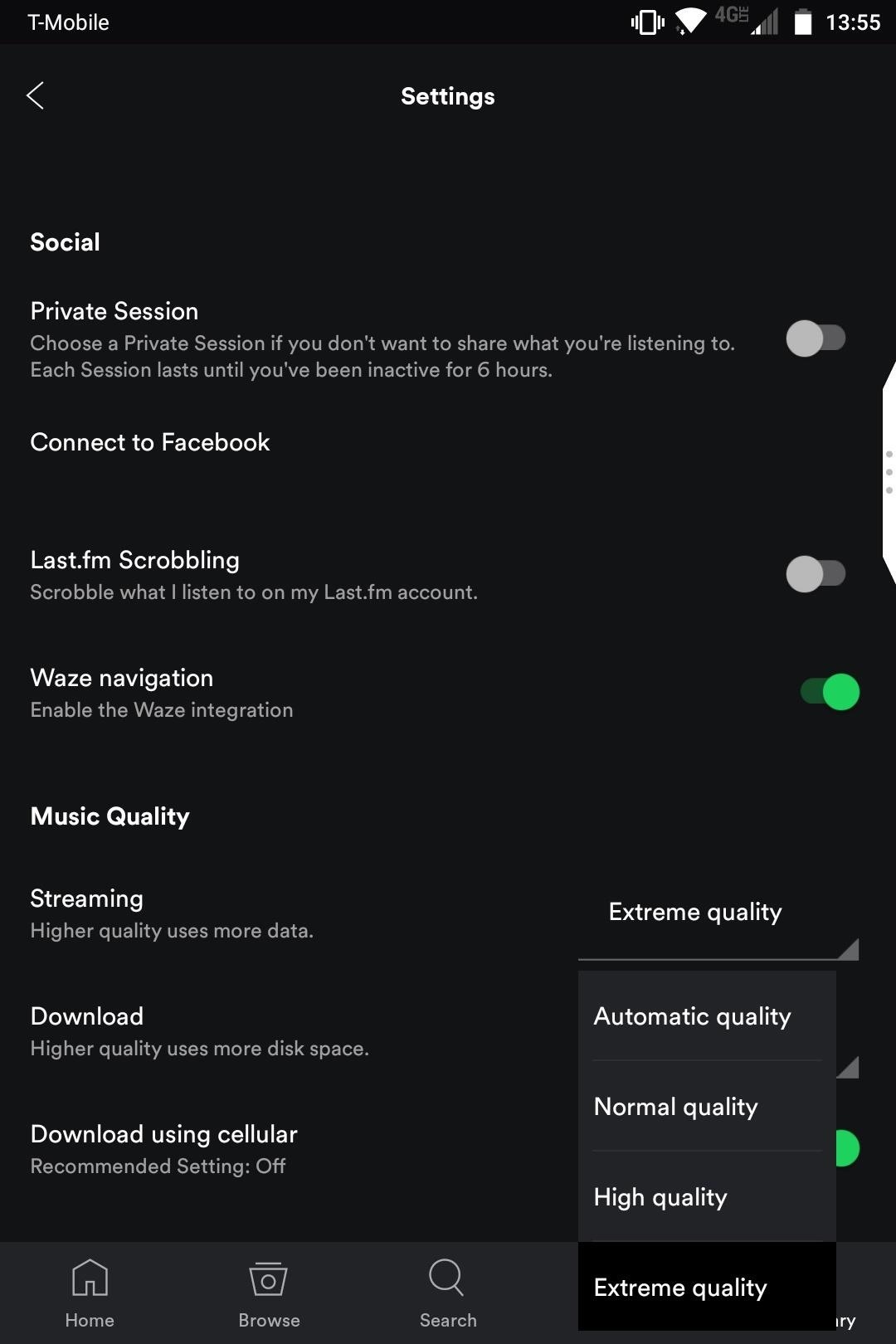
Step #3. Under Music Quality, you need to choose your preferred settings.
Next, select from the following audio quality settings, all in the Ogg Vorbis format: There are four options including Normal, High, Extreme, and Automatic.
How to Adjust Equalizer in Spotify on Android
Step #1. Launch Spotify on your Android device and click on Your Library in the menu at the bottom of the screen.
Step #2. Now, tap on the Settings icon.
Step #3. Under Music Quality, tap on Equalizer.
Now, you will be directed to your device’s Audio and Accessory settings. Next, you can select your preferred options.
Note: These settings may vary depending on your device.
How to Change Audio Settings in Spotify on Computer
Though desktop app’s standard quality High-quality at Ogg Vorbis 160kbit/s, Premium subscribers have the option to switch to High-quality streaming, which uses 320kbit/s.
Step #1. Open the Spotify app on your computer.
Step #2. Now, click on the downward arrow at the top-right corner and select Settings.
Step #3. Under Music Quality, turn on High-quality streaming (Premium only.)
You can also set the same volume level for all songs in Settings. Simply click SHOW ADVANCED SETTINGS and check out this useful feature under Playback.
That’s all folks!
Keep rocking
Amazon Vs Spotify Sound Quality
What’s your take on Spotify and its long dominance at the top of the ladder? Do share your thoughts with us.
What Is Spotify Audio Quality
You might want to refer these posts:
Jignesh Padhiyar is the co-founder of iGeeksBlog.com who has a keen eye for news, rumors and all the unusual stuff that happens around Apple products. During his tight schedule, Jignesh finds some moments of respite to share side-splitting contents on social media.
- https://www.igeeksblog.com/author/iosblogger/
- https://www.igeeksblog.com/author/iosblogger/How to Share Purchased Apps Between iPhones and iPads
- https://www.igeeksblog.com/author/iosblogger/
- https://www.igeeksblog.com/author/iosblogger/